She's Wild Fire: The Rebirth Drama That Treats 1991 Shenzhen as a Business Plan
A guide to the iQIYI short-form drama She's Wild Fire: a murdered businesswoman reborn in 1991 Shenzhen, 24 episodes of about twelve minutes, and what the show does with the city's boom years.
Why this one
If you have never watched a Chinese short-form drama, She's Wild Fire (她似野火) is an easy place to start. It runs 24 episodes of roughly twelve minutes each, about five hours in all. It premiered on iQIYI on October 9, 2026, with the whole run available to members by October 11. It is finished, so you can take it in one weekend.
It is also a good example of what the format does well. The idea fits in a sentence: a woman is killed in 2011, wakes up in 1991 with her memories intact, and decides to get rich and settle accounts. Almost every episode ends on a reversal, a public humiliation of a rival or a deal that goes her way. Shenzhen, the city that was then turning from a fishing district into a special economic zone, gives that fantasy a real economic backdrop: share prices, Hong Kong investors, garment factories, market streets.
This guide covers the whole show and keeps the ending to itself.
The setup
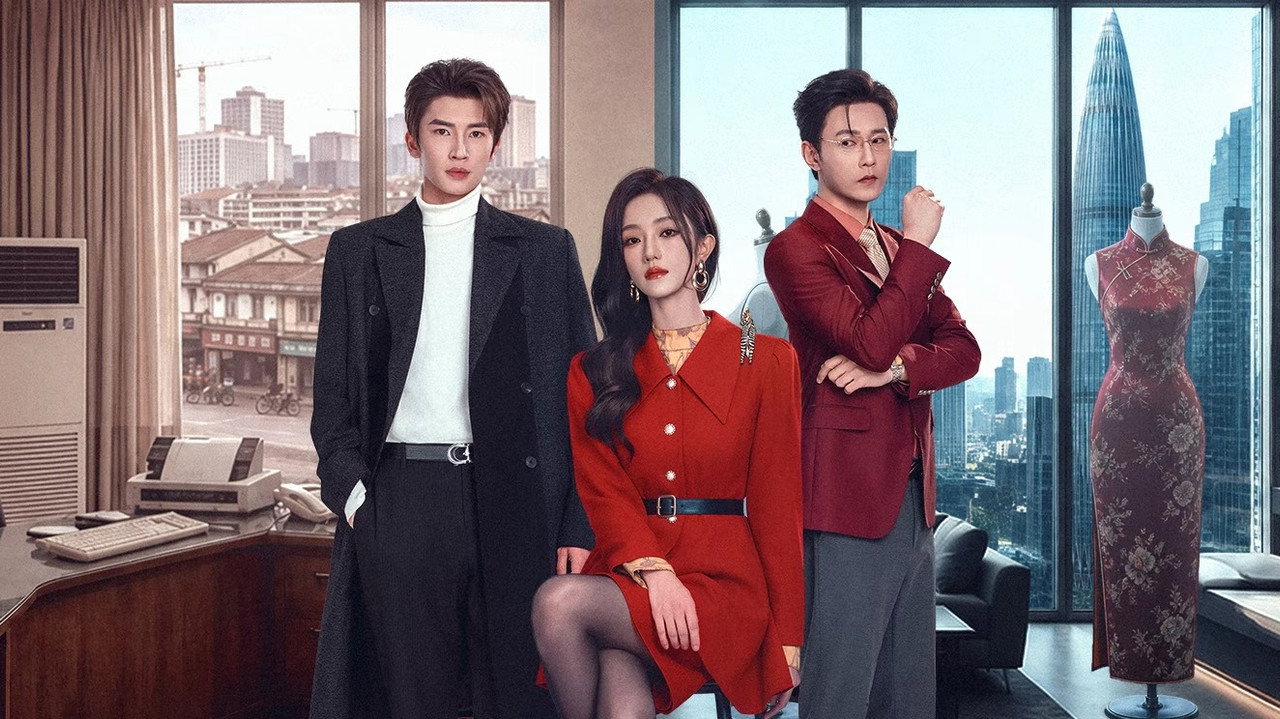
Xie Nanfeng (谢南风), played by Xiao Yan (肖燕), is a garment designer. In the opening episode, according to iQIYI's episode synopsis, she dies in 2011 after being forced off a building by Chang Yongbin (常永斌), a man who wants her design patent. She wakes up in 1991 in the same factory workshop, just as he moves to steal it, and fights him off.
Her first move is not to run but to find an ally. A Hong Kong businessman, Chu Chunsheng (楚春生), played by Qin Xiaoxuan (秦晓轩), is in town looking at investments. She recognizes him as the partner of her former enemy, and she decides to use his money and standing to change her fate. The early episodes follow her plan in steps: the patent, a quarrel with a family that wants to sell her into marriage, a bet on the stock market, and a future mother-in-law who wants her gone.
One structural choice is worth knowing before you start. The story does not stay in 1991. It jumps ahead by several years in the middle of the run, and the second half is about a woman who already has money and a brand and has to protect and expand them. If the first six episodes are revenge, the later ones are management.
Cast and crew
-
Xiao Yan (肖燕) as Xie Nanfeng, the reborn designer and entrepreneur
-
Qin Xiaoxuan (秦晓轩) as Chu Chunsheng, the Hong Kong businessman
-
Qi Shenghan (祁圣翰) as Chang Yongbin, her enemy from both lives
-
Liu Dexi (刘德熙) as A Zhi (阿芝), a loyal colleague
iQIYI credits Fan Jinxuan (范金轩) as director and Lu Youyou (鹿呦呦) as screenwriter. Other databases list different directors, so treat the director credit as unsettled; the platform's own page is the source used here. We found no reliable information on the production company, and the series is not adapted from a novel as far as we could confirm.
Rebirth as an investment strategy
The rebirth premise is old, but this show uses it in a specific way. Xie Nanfeng does not seek revenge by force. She uses hindsight the way an investor does. In the fourth episode she puts a large sum into Shenzhen Development Bank (深发展), an actual listed bank, and keeps adding as the day ends, while the traders around her expect a loss. The synopsis has the price jump to the daily limit on news of state support and Hong Kong capital. For the audience this works as a competence scene: the pleasure is watching someone act on knowledge nobody else has.
The same logic runs through her business moves. She quotes Chu a price of 110,000 yuan, 10,000 for the patent and 100,000 as the entry fee to a bigger deal, and turns down a promotion at the factory because she thinks the era is about to open up. Later episodes bring in a comfort-first bra without wires, pitched to women who work in the factory, and a reworked qipao (旗袍, the close-fitting Chinese dress) meant for the office rather than for special occasions. Both are shown as products with a market, not as costumes.
The cheat code has limits, and the show knows it. Foresight tells her what the market will do, not what people will do. Her antagonists, a plagiarizing classmate, her old enemy and a rival market landlord, are beaten by exposed evidence and well-timed leverage, and the plot keeps testing her business instinct against moments where she has to trust someone.
Shenzhen in the early 1990s
The official synopsis promises alley markets, a stock-market boom and industrial growth, and the episodes deliver all three in sequence. The Shenzhen Stock Exchange had been founded on December 1, 1990, so a character in 1991 queuing at a trading window is a plausible sight. A brick-sized mobile phone, the dageda (大哥大), rings at her waist as a status prop. Later settings include the Dongmen (东门) shopping district, the Shekou (蛇口) harbour, where she buys shipping capacity, and the Canton Fair (广交会) in Guangzhou, where her designs meet foreign buyers.
The show is a drama, not a history. It compresses a decade into a few years and the deals are made to fit the rhythm of twelve-minute episodes. What it does keep is the atmosphere of a city where new money, Hong Kong connections and ordinary workers meet. The synopsis pairs a woman's self-reliance with the city's image as open and inventive, so the series works as an advertisement for Shenzhen's self-image as much as a story.
A male lead who cries
The romance runs against the usual script. Chu Chunsheng is introduced as a rich Hong Kong investor, the type a Chinese romance would turn into a domineering boss. Instead he backs her, takes her side and sometimes breaks down. In the middle of the run he sits alone in a bar after seeing her with a senior fellow student from her years in the United States, and ends up in tears while telling her how insecure he feels.
His family adds the conventional pressure. His mother offers a large cheque and a prenuptial agreement that requires Xie Nanfeng to give up her career; this is the stock scene of the rich mother-in-law, and the heroine's response is to refuse and set her own price. The show then asks whether the couple can function as business partners as well as lovers, and the second half leans on that question.
A format note: 24 episodes in about two days
All 24 episodes were released to members within three days. iQIYI opened with 12 episodes on October 9, added four on October 10 and put out the remaining episodes on October 11, according to HK01 and platform listings. For anyone who follows weekly dramas, this is a different habit: the show is meant to be watched in one sitting, and each episode needs a hook.
Non-members could watch certain episodes during limited free windows, and iQIYI has promoted episodes of the show for free. Those windows change, so what is free for you depends on the day.
Where to watch
The series is an iQIYI release in China. For overseas viewers, we did not find an official international listing, so check iQIYI's international app or site in your country; availability varies by region, and we could not confirm English subtitles.
Want to talk about this? Join the conversation on our Discord →
Get the newsletter
New drama guides, news and reviews in your inbox. No spam, unsubscribe any time.
Or subscribe by RSS: feed.xml