Royal Nirvana: A Crown Prince Caught Between Father and Throne
A guide to Youku's 2019 court tragedy about an heir who can never tell his father from his sovereign — its Song-dynasty rituals, the fight over its pain, and the 12 episodes that were cut and released on their own.
Why this one
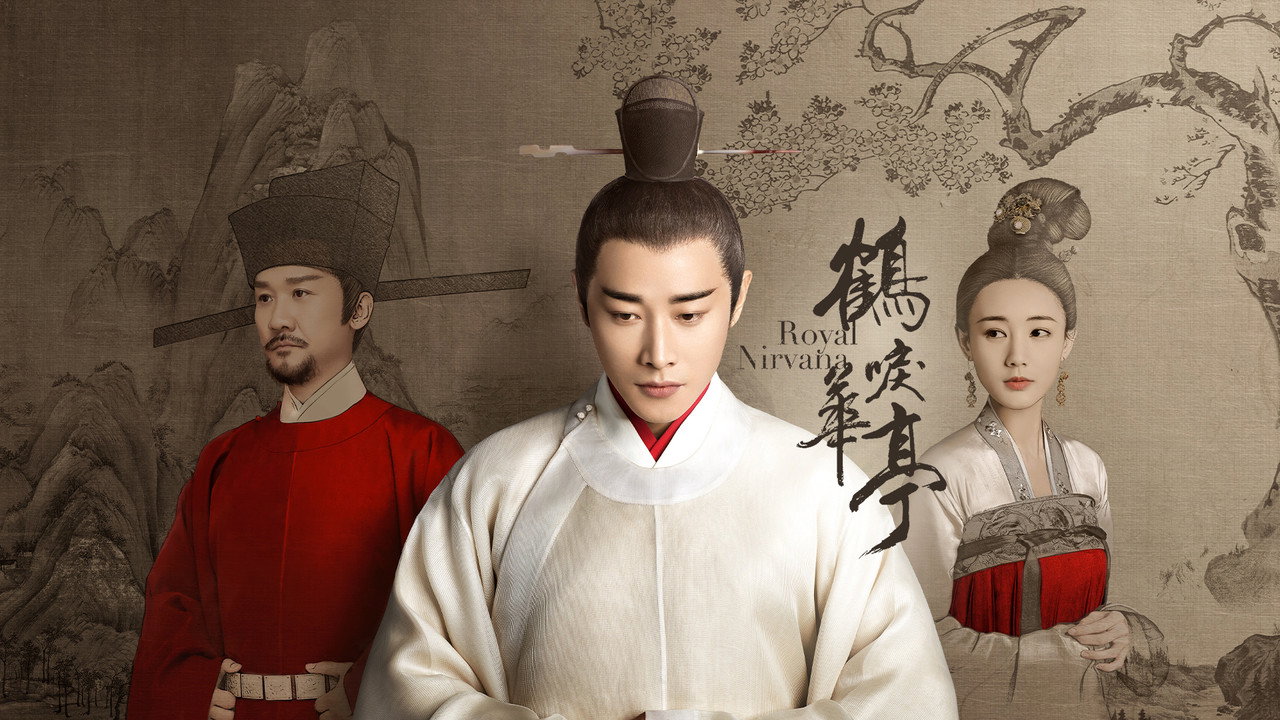
Most costume-drama heroes win. Xiao Dingquan (萧定权), the crown prince of Royal Nirvana (鹤唳华亭), wins too: case after case, scheme after scheme. And after every victory he has a little less than before. The drama premiered on Youku (优酷) on 12 November 2019 and ran 60 episodes, adapted from a web novel by Xue Man Liang Yuan (雪满梁园), who also wrote the screenplay. Its central relationship is not a romance and not a palace rivalry. It is the one between a prince and the emperor who is also his father.
That made it unusual in its season, and it split its audience. Douban (豆瓣), China's main user-review site, split into high scores and low ones, and some viewers gave up halfway because watching the leads suffer was simply too much. Six years on, that argument is part of what the show is.
The title comes from an old story. In the Shishuo Xinyu (世说新语, "A New Account of the Tales of the World"), the poet-official Lu Ji (陆机), about to be executed in 303, asks whether he will ever again hear the cranes crying at Huating (华亭), his home. "The cry of the cranes at Huating" became shorthand for regret too late, for a life that politics swallowed. Put it on a crown prince and you have already been told how this ends. The heroine's first scene plays with the same image: she remarks that the crane, for all its elegance, is a bird of prey.
The setup
The prince is twenty when the story opens. He has just finished three years of mourning for his mother and still has not been capped. The capping ceremony, guan li (冠礼, "the coming-of-age rite for a young nobleman"), is no formality here: for an heir, being capped means being allowed into government. The emperor keeps postponing it. Meanwhile the emperor's eldest son, the Prince of Qi (齐王), born to a concubine, already capped and married, has somehow never left the capital for his fief, and the chancellor Li Baizhou (李柏舟), the Prince of Qi's father-in-law, keeps pushing his cause.
Lu Wenxi (陆文昔), an official's daughter, crosses the prince's path in a scandal over the civil-service examinations. When disaster falls on her father and brother, she enters his household in disguise as a palace official. From there the story runs as a chain of "cases" — the capping case, the exam leak, the warhorse case, the nursery-rhyme case — each a contest of wits, each ending in a reversal.
The dynasty is invented, so no history homework is needed, though everything you see points to the Song (960–1279). The dialogue, on the other hand, is dense with classical allusion. The cast admitted that the script's rare characters sent them to the dictionary.
The father who is also the sovereign
The show states its problem in one line. The emperor, Xiao Ruijian (萧睿鉴), explains why he treats his two sons differently: his eldest is first his son; the crown prince is first his subject. Chinese has a word for the double role he holds over the heir: jun fu (君父, "sovereign-father"), the man owed both a son's devotion and a subject's obedience. Xiao Dingquan answers it in a line viewers still quote: if the sovereign and the father are heaven, and the subject and the son are earth, then between heaven and earth, where is the person?
Chinese critics read the trap as structural — four locks, each holding the others shut.
The consort clan. The emperor reached the throne with the help of his late wife's family, the Gu. That makes the crown prince half Gu, and it makes the emperor's relationship to him the one Chinese history knows well from the waiqi (外戚, "consort clan": the relatives of an emperor's wife or mother) — dependence and fear in equal measure. The writer Zeng Yuli (曾于里), reviewing the premiere for The Paper (澎湃新闻), makes the point that the emperor is no fool: he knows the crown prince is the ablest of his sons, which is exactly why he resents him in private and never quite deposes him in public.
The army. The prince's uncle, the Marquis Gu Silin (顾思林), commands the Changzhou frontier army, two hundred thousand men, most of them his old subordinates. Every move the prince makes is read in the palace as a move of that army.
The balance. The emperor raises the Prince of Qi to check the crown prince, and uses the crown prince to check the Gu. One Douban reviewer put the engine of the whole tragedy in an old maxim: a ruler who doubts his minister kills him; a minister who doubts his ruler rebels. Neither man here can stop doubting.
The son. Under all the politics, Xiao Dingquan simply wants his father to love him. Luo Jin (罗晋), who plays him, told Beijing Daily (北京日报) that the prince believes, at bottom, that his father does love him, and spends the drama looking for proof — and that the ordinary reserve of a Chinese father and son is here doubled by the question of ruler and subject. Zeng compares the story to the Korean film The Throne (思悼, 2015), in which a king destroys his own heir; the difference, he notes, is that Xiao Dingquan is never allowed the release of going mad.
So the prince keeps winning rounds and keeps losing the game, because the final judgement always belongs to one man. That is also why the show feels unlike most costume drama of its time. Plenty of recent heroes carry modern ideas into an old world and are vindicated by them. This one stays inside the feudal court and asks what duty to a ruler and duty to a father do to a person when they are owed to the same man.
The reading has its sceptics. A one-star Douban review from 2024 argues that a crown prince with no appetite for power, in a court where heirs are forbidden to touch government, doesn't hold together politically. Another viewer noticed that the characters talk about law more fluently than the plot ever applies it. You have to accept the show's premises for the tragedy to work, and not everyone does.
Melodrama or tragedy?
Two reactions sit side by side. One calls Royal Nirvana a true tragedy, its sorrow built into the structure. The other calls it a drama that wounds its characters for effect. What viewers keep reaching for is a question: what separates sa gou xue (洒狗血, literally "splashing dog blood", slang for overwrought melodrama) from tragic beauty?
The show gives evidence to both sides.
The case for tragedy. Liu Yanqiu (刘燕秋), writing for Jiemian (界面新闻), files the show under nue ju (虐剧, "torment drama"), a genre usually about lovers who hurt each other. This one moves the torment to the bond between emperor and heir — and that, she argues, is why it can never become a payoff drama: however many twists the prince survives, he loses. One long Douban post reads his anguish as the cost of a moral code in which any feeling beyond the permitted bounds — his devotion to his tutor, his closeness to his uncle — counts as desire to be suppressed. On that reading, the suffering would come whatever the plot did, because it comes from who he is.
The case against. The low scores on Douban mostly cite reversals "for the sake of reversal", and twists explained through hastily added flashbacks. Viewers nicknamed them "Russian-doll reversals"; one count found nearly ten in the opening capping case alone. The heroine hides her identity for so long that the couple's recognition of each other drags. Even a reviewer who admired the tragic foundations thought the supports were thin, resting largely on an information gap created by a single decision of hers. Another, rewatching in 2025, called stretches of it torment for torment's sake — while admitting that the point of tragedy is that it stays with you, and this one did.
Here is a way to hold the two together. Ask of each blow: would it have been avoided if one person had known one more fact? Where the answer is yes, the pain is accident, and accident is what melodrama runs on. Where the blow would have landed anyway, because of who these people are and where they stand, it is tragedy. Royal Nirvana has both kinds, and its viewers have mostly been arguing about the ratio.
There is also pleasure mixed in with the pain. The early cases deliver exactly the satisfaction of a good scheming drama: each hides five or six reversals, and watching the prince think his way out is fun. The pain comes later, as the people around him fall away one by one. Director Yang Wenjun (杨文军) has defended the choice: tragedy, he said, lets viewers release what they have held in — "a kind of detox".
Song objects, early Ming rules
Royal Nirvana was built as a showcase of ritual. Before broadcast the production released videos on whisked tea and movable type, had court music reconstructed from historical records, and worked the cha shou li (叉手礼, "folded-hands salute", a gesture of respect from the Tang and Song) into the court scenes. "It may be fiction, but historical detail is essential," Yang told China Daily; borrowing Song ritual, he said, let beauty be expressed more quietly.
Three things carry the most weight on screen:
-
The capping ceremony, which opens the story and sets its stakes: a rite that is also a political prize.
-
Whisked tea, dian cha (点茶, powdered tea beaten into a foam with a bamboo whisk, the Song way of drinking it). The tea scenes recur, and they do quiet work: in one night visit to his tutor, the ritual of preparing the tea carries what the conversation leaves unsaid.
-
The screen, ping feng (屏风). The best-loved romantic scene has Lu Wenxi and the prince on either side of a standing screen, books laid out to air in the sun, pages turning in the breeze — talking without seeing each other's faces. For many viewers it is the scene they remember first.
The costumes speak the same language. The emperor's most frequent grey-blue robe is lifted from Listening to the Qin (听琴图), a painting attributed to the Song emperor Huizong (宋徽宗), and the court rites follow Five Dynasties and Song practice.
But "Song" needs a footnote, and the novel's author supplied it herself: objects, costume, art and customs follow the Song, while statutes, institutions and ritual follow the early Ming. The drama mostly kept to that split, and sharp-eyed viewers caught it — the nine-tasselled crown at the capping looks very like one excavated from a Ming prince's tomb. The objects are Song; the rules of the court are not.
Luo Jin's crown prince
Luo Jin was 37 when the drama premiered, playing a prince who is twenty in the first episode. Audiences noticed, and the gap frames every argument about the performance.
The character rests on a trait the press and the show's own synopsis call "timid in small things, brave in great ones" (小怯而大勇). Luo's opening episodes establish the timidity, so that the courage, when it comes, costs something.
The criticism is just as persistent: he cries. Viewers joked in the bullet comments that this crown prince weeps too much; one tally counted seventeen or eighteen times in five episodes. A Douban reviewer complained that every crying scene gets the same treatment — grief, despair, fear, pleading — and set it against a famous confrontation in Nirvana in Fire (琅琊榜). Another called the tears "cheap", doubting that a man beaten down for over a decade would still weep so readily.
Luo's answer was that none of the crying was planned; each time it came out of the scene. He saw the part as showing a crown prince's vulnerability rather than his authority — a man asking, again and again, what he is to his father. He also paid for it: the director said Luo was so drained that he sat limp for two or three hours after each day's shoot.
Those who rate the performance tend to point to how he holds the split — a clear political mind inside a child who never got to grow up. One viewer, on a fourth rewatch in 2025, admitted that much of the discomfort comes from seeing a man near forty in the role, and still felt that the character spends the whole drama searching for love.
A well-made drama that didn't break out
On paper Royal Nirvana opened well: 7.7 on Douban, settling around 7.5 during its run (it stands at 7.1 today), and the top spot on Guduo's daily online-drama chart at launch. Beijing Daily credited it with reviving the male-led costume drama. Yet the word critics kept using was "gap" — between how good people said it was and how many were watching.
The obvious culprit started two weeks later. Joy of Life (庆余年) arrived on Tencent Video and iQiyi on 26 November, hit 8.0 on Douban within twenty days, and took over the conversation. Several other explanations circulate.
It isn't shuang. Shuang (爽) is the pleasure of a payoff — the hero leveling up, the enemy humiliated on cue. Against shows built on that, one Jiemian critic wrote, Royal Nirvana was "not satisfying enough — or satisfying in a very particular way". Viewers in the bullet comments half-joked about wanting to "borrow a father" from Joy of Life. The two shows were compared constantly, and the comparison was never in the tragedy's favour.
The release pattern. It was a Youku exclusive, and its weekly rhythm wandered — three episodes a week, then one or two, then sudden extra drops. The comments filled with complaints about slow updates. And unlike many hits of 2019, it was not simulcast on a second platform, which likely kept it in front of fewer viewers.
The calendar. Costume dramas were thin on the ground that year. Filings for new costume dramas on the national registration platform fell from 151 in the first ten months of 2018 to 47 in the same period of 2019. That gave Royal Nirvana a fairly open field — until Joy of Life filled it.
The fairest summary is that the show did well and was overshadowed, and that the very things its admirers love about it — the slow build, the refusal of payoff — are the things that kept it from a wider audience.
The novel, the 60 episodes and the 12
Spoilers for the ending follow.
The novel was serialised on Jinjiang Literature City (晋江文学城) and runs to about 420,000 characters. Its ending is bleak: the prince gives up his military command to protect the realm, is held prisoner for the rest of his life, and dies under a lasting bad name. The drama changes a great deal of the plot while keeping the characters and their relationships, and it warms the book's cold father–son bond. Since the novelist wrote the screenplay herself, those changes are hers.
The broadcast finale, on 6 January 2020, leaves the prince's fate open: his father teaches him the tea method; he and Lu Wenxi have a child; whether he lives is never said. Viewers called the final stretch rushed, and they had a point — the production had cut a 72-episode series down to 60.
The missing material reached Youku on 22 September 2020 as a separate 12-episode title, Bie Yun Jian (别云间, "Farewell to Yunjian" — Yunjian being an old literary name for the Songjiang area where Huating lay). It was billed as a side story, fan wai (番外), with the same director and most of the original cast. In it, after the Prince of Qi is banished, Xiao Dingquan hopes to live quietly with Lu Wenxi, but finds her being coerced by an unseen hand; a plot to frame him for treason with forged letters to the army camps forces the question of whether he will take up arms against his father; news comes that his uncle is dead, and he rides to Changzhou to calm the army; and the emperor, at last regretting what he has done to his son, apologises.
Youku and the producers have not publicly explained why this material was cut and released on its own. What is clear is the effect: anyone who stops at episode 60 has watched a story with its last act missing.
Cast and crew
Yang Wenjun directed; his earlier work includes the fantasy drama Legend of Fuyao (扶摇, 2018). Xue Man Liang Yuan wrote the screenplay from her own novel. The production companies were Youku, Fei Fan Xiang (非凡响), China Wit Media (中汇影视), Alibaba Pictures (阿里影业) and Saren Media (仨仁文化). The shoot took 216 days, with locations in Zhejiang, Gansu and Xinjiang. Zhou Shen (周深) sings the theme song, "Wishing for a Single Heart" (愿得一心人).
-
Luo Jin (罗晋) as Xiao Dingquan, the crown prince
-
Li Yitong (李一桐) as Lu Wenxi
-
Huang Zhizhong (黄志忠) as the emperor, Xiao Ruijian
-
Wang Jingsong (王劲松) as the prince's tutor, Lu Shiyu (卢世瑜)
-
Zhang Zhijian (张志坚) as the chancellor, Li Baizhou
-
Zheng Yecheng (郑业成) as the prince's cousin, Gu Fengen (顾逢恩)
-
Jin Han (金瀚) as the Prince of Qi
-
Liu Dekai (刘德凯) as the Marquis Gu Silin
-
Miao Pu (苗圃) as Consort Zhao (赵贵妃)
Where to watch
In China, Youku streams both the 60 episodes and the 12-episode Bie Yun Jian, listed as separate titles. Outside China availability varies by region and changes over time; check what is offered where you are, and whether it includes the 12.
Overseas reception
China Daily reported in November 2019 that the series was streaming in more than 200 countries and regions, through outlets including YouTube, Amazon Prime Video and Malaysia's Astro; TV broadcasts followed in Malaysia, Singapore and Taiwan. In English it found a small, devoted following rather than a mass one — a multi-part podcast series from Chasing Dramas, fan blogs, viewers comparing notes on the ending. One blogger in late 2020 was surprised by how well Luo Jin cried, worn out by the prince's endless need for his father's approval, and baffled by the finale. That confusion is easy to explain: for most overseas viewers, the 12 episodes that finish the story were never part of the show.
Want to talk about this? Join the conversation on our Discord →
Get the newsletter
New drama guides, news and reviews in your inbox. No spam, unsubscribe any time.
Or subscribe by RSS: feed.xml